What an Inground Pool Actually Costs in Chattanooga
Real ranges, the ground conditions that move them, and which local office issues your permit. No form required to see the numbers.
Three ways to build, three different numbers
| Vinyl liner | Fiberglass | Gunite / concrete | |
|---|---|---|---|
| Typical installed range | $25,000–$65,000 | $45,000–$100,000 | $50,000–$120,000+ |
| Build time | 4–6 weeks | 2–4 weeks | 8–12 weeks |
| Shape options | Limited to panel kits | Manufacturer's molds only | Anything you can draw |
| Recurring cost | Liner replacement every 5–15 years, $3,000–$7,500 | None structural | Resurface every 10–15 years, $6,000–$15,000 |
| Annual upkeep | $1,000–$2,000 | $500–$1,500 | $2,000–$4,000 |
Tennessee-specific numbers exist for fiberglass because the manufacturers survey their dealers. A 2026 survey of 20 Tennessee dealers put a small fiberglass pool at $74,211, a medium at $93,421, and a large at $113,158 — those are turn-key figures including excavation, equipment, basic electrical, permits, water, and roughly three feet of concrete around the pool.
The national average for an inground pool is about $66,000. We publish that number knowing it is close to useless on its own: the same pool costs different money in Ooltewah than it does on Signal Mountain, and the reason is almost always what the excavator finds three feet down.
Ranges on this page are published market data, not our quote. Yours depends on what is under your yard, how the equipment gets there, and how much concrete you want around the water.
In Hamilton County, the hole is the variable
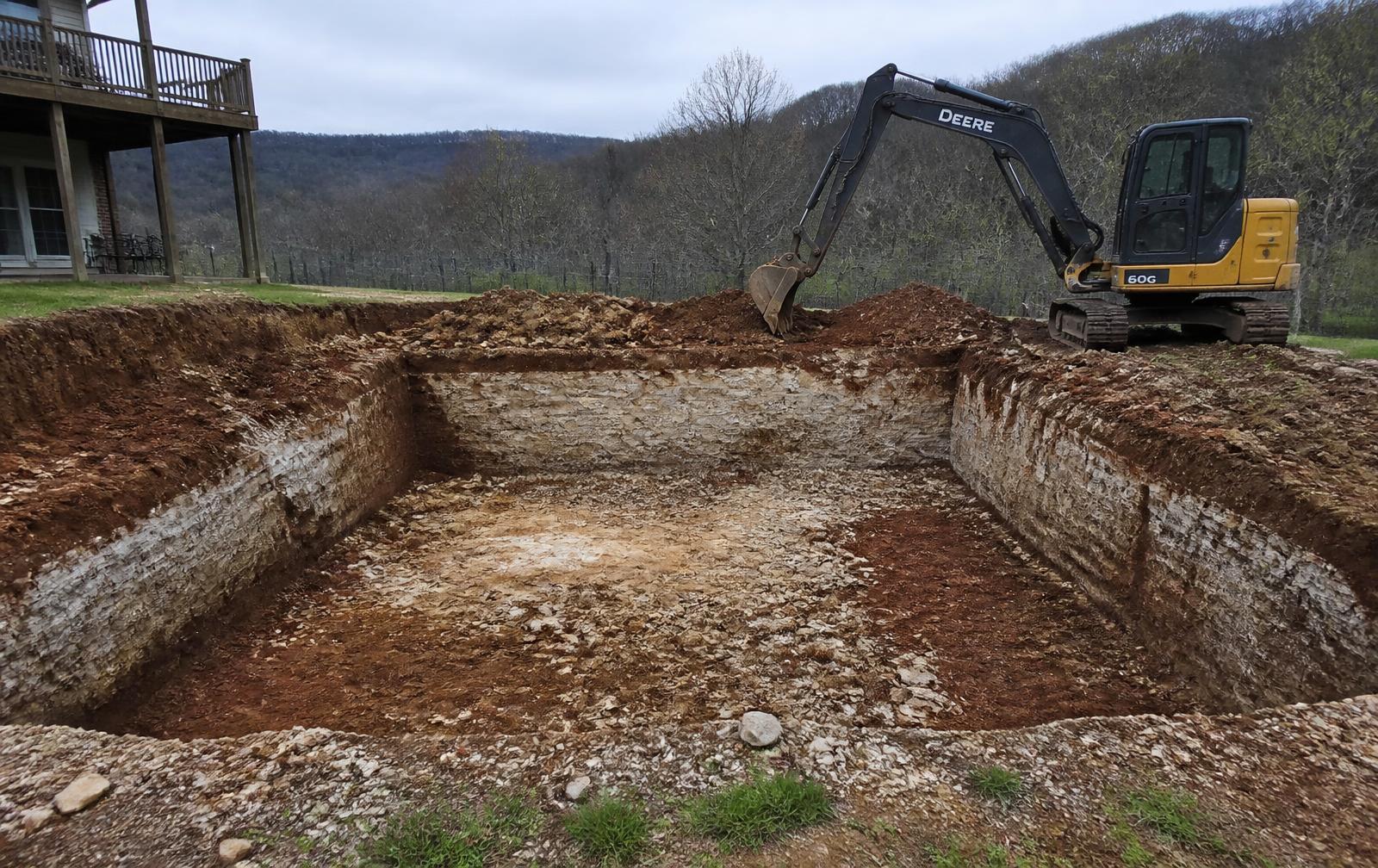
Chattanooga sits in the Valley and Ridge — folded belts of Paleozoic limestone, dolomite, sandstone and shale running southwest to northeast. What that means for a pool is that depth to rock is not a lottery. It is mapped, and it varies enormously across a few miles.
The USDA soil survey for Hamilton County puts hard numbers on it. The Fullerton–Bodine soils covering roughly 48% of the county sit more than five feet over limestone and are full of chert. Talbott soils hit bedrock at 20 to 40 inches. On the ridges, Ramsey soils reach sandstone in under 20 inches, and Montevallo hits weathered shale in under 20. A pool needs a hole between five and eight feet deep. On several of those map units, you are in rock before you are halfway there.
Then there is the clay problem. Colbert soils — about 10% of the county — carry high shrink-swell potential and very slow permeability. The survey's own language is blunt: "poorly suited to building sites, roads, and most other engineering uses." That is a backfill and hydrostatic-pressure problem, not a digging problem, and it is why a pool that went in cheap can move.
And the county is karst. USDA notes that some areas here "are drained by underground caverns."
What rock costs
The same Tennessee dealer survey puts excavation in rocky soil at about $4,500, against roughly $1,200 in sand and $1,294 in clay. When a hoe-ram has to come in, that job typically runs $3,500 to $5,500 and takes a day or two. A sloped lot needing extra grading adds about $3,356. A backyard with no equipment access adds about $4,300.
Those three line items are the single biggest reason two quotes for "the same pool" differ by twenty thousand dollars.
Full Chattanooga pool cost breakdown →How gunite pools are built here →
Eight offices, one of them is yours
Hamilton County has an unusual number of separate building-inspection offices, and which one you deal with depends on which side of a line your house sits on. Chattanooga, Collegedale, Soddy-Daisy, Signal Mountain, Red Bank, East Ridge and Lookout Mountain each run their own — and everything outside a city limit goes to Hamilton County. Eight offices in all.
Hamilton County adopted the 2018 International Swimming Pool and Spa Code on September 15, 2021, effective January 1, 2022. Every inground pool needs a permit. The only exemption is a prefabricated above-ground pool under 24 inches deep holding 5,000 gallons or less.
Pool construction services in Chattanooga
Gunite & Concrete Pools
Steel-reinforced shells shot in place, so the shape, depth and tanning ledge are drawn rather than ordered.
Fiberglass Pools
A one-piece molded shell set in the hole; the shortest build window of the three methods.
Vinyl Liner Pools
Panel-and-brace walls with a replaceable membrane, and the lowest entry cost of the three.
Pool Renovation & Resurfacing
Replaster and resurface work, tile and coping replacement, and equipment-pad rebuilds on existing pools.
Spas & Water Features
Attached spas sharing the pool's equipment, plus sheer descents, bubblers and raised walls.
Decking & Hardscape
The concrete, pavers and retaining walls around the water, which on a sloped lot is often the bigger number.
Where the work happens
Terrain and permit authority both change between these towns — a ridge lot in Signal Mountain and a valley lot in Ooltewah are different digs filed with different offices.
The build calendar here
Chattanooga averages 46 days a year at or above 90°F. The median last spring frost is April 4 and the first fall frost is October 31. That is the swimming window, and it is why the smart build calendar runs backwards from it: a gunite pool takes 8 to 12 weeks of construction, so a pool you want to swim in by Memorial Day is a conversation that starts in January, not April.
The county also gets 55 inches of rain a year — the wettest stretch is winter and early spring, and an open excavation in a wet February is how schedules slip.
Questions we get first
- How much does an inground pool cost in Chattanooga?
- Market ranges run about $25,000–$65,000 for vinyl liner, $45,000–$100,000 for fiberglass, and $50,000–$120,000+ for gunite. A 2026 survey of 20 Tennessee fiberglass dealers put a small pool at $74,211, a medium at $93,421 and a large at $113,158, turn-key. These are published market figures, not our quote.
- What happens if they hit rock?
- Excavation in rocky soil runs about $4,500 in the Tennessee dealer survey, against roughly $1,200 in sand and $1,294 in clay. If a hoe-ram is needed, that work typically costs $3,500 to $5,500 and takes a day or two. Ask any builder how their contract handles rock before you sign.
- Do I need a permit for a pool in Hamilton County?
- Yes. Hamilton County adopted the 2018 International Swimming Pool and Spa Code on September 15, 2021, effective January 1, 2022. Every inground pool needs a permit. The only exemption is a prefabricated above-ground pool under 24 inches deep holding 5,000 gallons or less.
Get a straight number
Send the address and roughly what you want in the ground, and you'll get a straight answer on what the ground is likely to do to the number.